
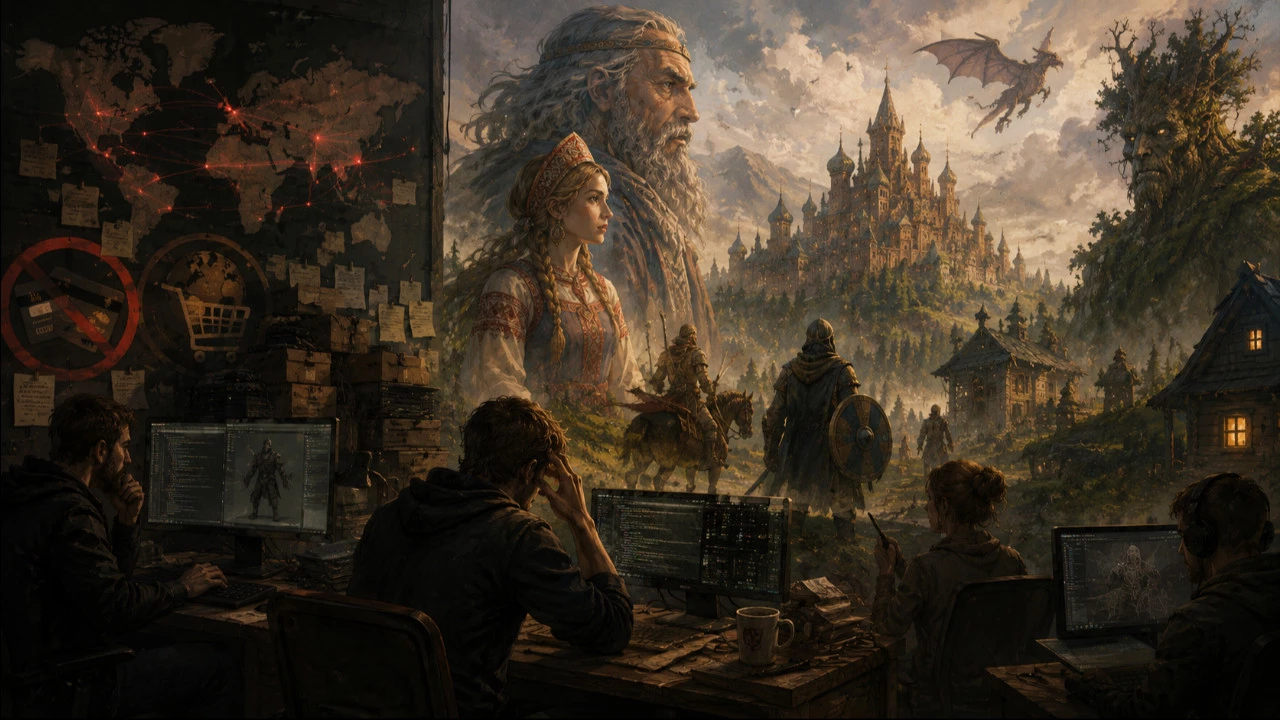
Navigating Sanctions and Embracing Slavic Identity: How Russia’s Game Development Industry Adapts to Survive
The Russian video game development industry finds itself at a critical crossroads as international sanctions continue to reshape the landscape of global gaming. A comprehensive survey conducted by Kinopoisk, Russia’s leading entertainment platform, interviewed more than twenty executives from prominent Russian game studios to assess the current state of the industry. The findings reveal an ecosystem under significant pressure, yet one that demonstrates remarkable adaptability and creative resilience in the face of unprecedented challenges.
The Sanctions Barrier: Payments, Platforms, and Distribution
The main issue occupying discussions among industry leaders centers on the effects of Western sanctions enacted in response to geopolitical conflicts. These measures have established an intricate network of challenges impacting nearly all facets of game development and distribution. Russian developers currently encounter significant hurdles in gaining access to international payment systems, publishing platforms, and critical software tools that constitute the foundation of contemporary game creation. Steam, the globe’s biggest digital distribution platform for PC games, has limited payment processing for Russian users, while Apple and Google have enacted comparable restrictions on their mobile app stores.
The Software Licensing Crisis
Perhaps the most immediate and tangible challenge facing Russian studios is the issue of software licensing. Industry-standard tools such as Unity and Unreal Engine, which power the majority of contemporary video games, have become increasingly difficult to access through legitimate channels. Adobe Creative Suite, Autodesk Maya, and other essential creative software present similar obstacles. This has forced many studios to explore alternative solutions, including open-source software like Blender and Godot Engine, or to develop elaborate workarounds that some industry insiders humorously refer to as “quests” for obtaining necessary tools. The transition away from familiar software ecosystems requires significant investment in retraining staff and adapting established workflows.
Financial Infrastructure Challenges
Financial infrastructure represents another critical pressure point for Russian game developers. International payment processors including PayPal, Visa, and Mastercard have suspended or severely limited operations in Russia, making it extraordinarily difficult for studios to receive payments from international customers or pay overseas contractors and service providers. Many companies have been forced to establish complex payment chains through third countries or cryptocurrency solutions to maintain any semblance of international commerce. This financial isolation has pushed numerous studios to pivot their focus toward domestic and regional markets, including the Commonwealth of Independent States and other nations maintaining economic ties with Russia.
The Rise of Slavic Cultural Identity in Gaming
In response to these external pressures, a notable cultural shift has emerged within the Russian gaming industry. Many developers are increasingly embracing distinctly Slavic themes, aesthetics, and storytelling traditions in their projects. This trend toward “Slavic colorit” — a term describing the unique cultural flavor of Eastern European and Russian heritage — represents both a pragmatic market strategy and a genuine creative movement. Games featuring Slavic mythology, Russian folklore, historical settings from Medieval Rus to the Soviet era, and distinctly Eastern European visual styles are proliferating. This cultural emphasis helps studios differentiate their products in global markets while also resonating strongly with domestic audiences who may have limited access to Western gaming content.
Historical precedent suggests that periods of isolation and constraint can paradoxically foster innovation in creative industries. The Soviet film industry, despite severe restrictions, produced internationally acclaimed works that developed distinctive aesthetic and narrative approaches. Similarly, Japanese game developers in the 1980s and 1990s created unique gaming experiences that eventually conquered global markets. Russian game development has its own legacy of success stories, from the puzzle phenomenon Tetris created by Alexey Pajitnov in 1984 to more recent hits like Escape from Tarkov and Atomic Heart. Industry veterans point to these examples as evidence that creative talent can thrive despite — or perhaps because of — challenging circumstances.
Domestic Market Opportunities and Government Support
The domestic Russian gaming market, while smaller than Western counterparts, remains substantial and continues to grow. Russia historically ranked among the top fifteen gaming markets globally, with tens of millions of active players across PC, console, and mobile platforms. With reduced access to certain international titles and services, Russian players may increasingly turn to domestically produced content, potentially creating new opportunities for local developers. Government initiatives have also emerged to support the digital creative sector, though industry participants express mixed opinions about the effectiveness and accessibility of such programs.
Adapting for an Uncertain Future
Looking ahead, Russian game development studios face an uncertain but not necessarily bleak future. The industry demonstrates significant adaptability, with companies restructuring operations, relocating staff to neighboring countries, establishing international subsidiaries, and fundamentally reimagining their business models. While some studios have contracted or shuttered entirely, others report continued growth and successful project launches. The coming years will likely determine whether these adaptation strategies prove sustainable long-term or merely represent temporary measures in a fundamentally transformed global gaming landscape.