
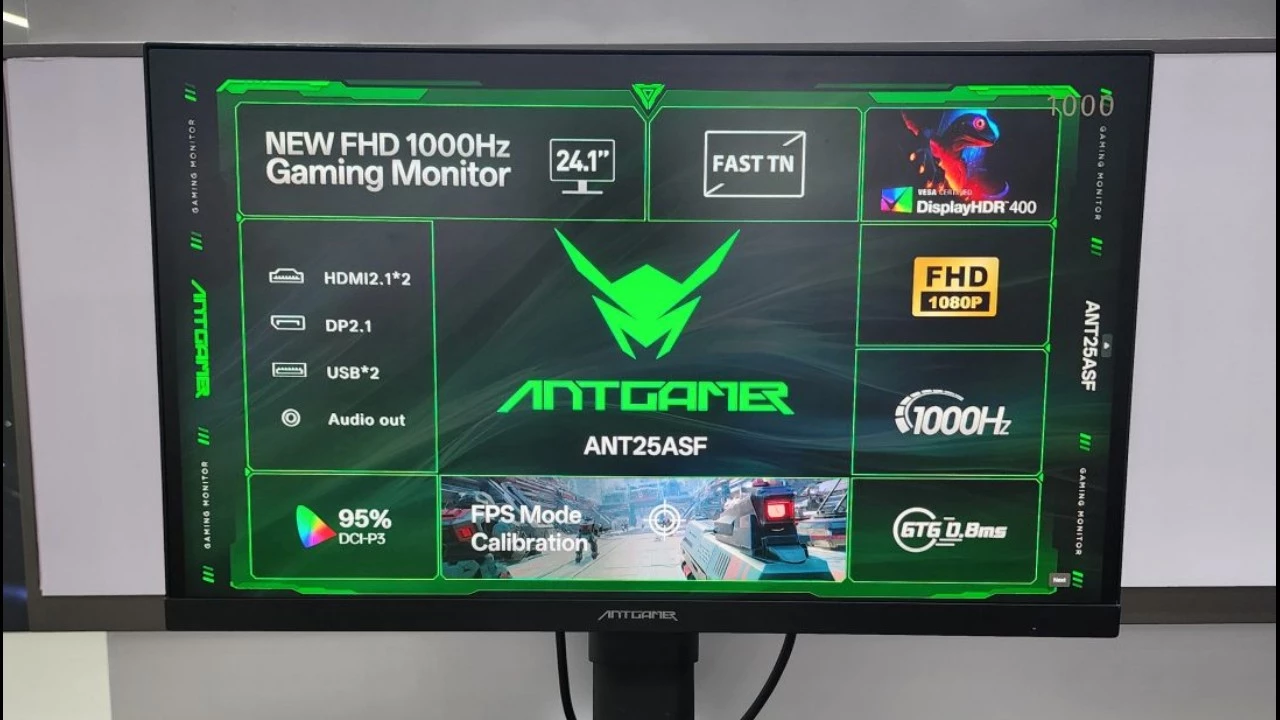
AntGamer Unveils 1000Hz Gaming Monitor, Pushing Display Technology to New Extremes
Chinese display manufacturer AntGamer, a subsidiary of the renowned HKC Group, has officially unveiled its latest lineup of gaming monitors, with the flagship ANT25ASF stealing the spotlight as the world’s first Full HD monitor to achieve an astounding 1000Hz refresh rate. This groundbreaking display is specifically designed for professional esports athletes and competitive gamers who demand the absolute pinnacle of visual fluidity and responsiveness in their gaming experience.
Breaking the Refresh Rate Barrier
The ANT25ASF marks an extraordinary advancement in display technology, essentially doubling what had previously been regarded as the pinnacle of consumer gaming monitors. Not long ago, 240Hz displays were deemed groundbreaking, while 360Hz monitors were seen as the ultimate competitive gaming equipment. The leap to 1000Hz appeared to be the stuff of science fiction, yet AntGamer has transformed it into a commercial product. The monitor boasts a 24.5-inch TN panel with 1920×1080 resolution, a configuration that emphasizes pure speed over visual quality, remaining faithful to its competitive gaming orientation.
The Science Behind Ultra-High Refresh Rates
The science underlying ultra-high refresh rate displays explains why this technology holds such significance in competitive gaming. At 1000Hz, a fresh frame reaches the screen every single millisecond, in contrast to roughly 4.17 milliseconds at 240Hz or 16.67 milliseconds at conventional 60Hz. This substantial decrease in frame delivery time results in considerably reduced input lag and motion blur, providing players with a concrete competitive edge in fast-paced games where milliseconds can mean the difference between winning and losing. Professional Counter-Strike, Valorant, and Overwatch players have long championed higher refresh rates, asserting they can detect differences that casual gamers might consider unnoticeable.
Technical Trade-offs and Panel Technology
However, pushing refresh rates to such extreme levels comes with significant technical challenges and trade-offs. The ANT25ASF utilizes a TN (Twisted Nematic) panel rather than the more visually impressive IPS or VA technologies. TN panels are known for their faster response times but suffer from inferior color accuracy, narrower viewing angles, and reduced contrast ratios. For competitive esports, where players sit directly in front of their monitors in controlled environments, these limitations are considered acceptable sacrifices for the performance gains. The monitor reportedly achieves a 1ms gray-to-gray response time, ensuring that the panel can actually keep pace with the 1000Hz refresh rate without introducing significant ghosting or motion artifacts.
The Evolution of Gaming Displays
The historical progression of gaming monitor technology provides important context for understanding this achievement. The industry began with 60Hz CRT monitors in the 1990s, which some professional gamers actually pushed to 100Hz or higher through custom configurations. The LCD era initially represented a step backward in terms of refresh rates, with early flat panels struggling to match CRT performance. It wasn’t until around 2012 that 120Hz LCD gaming monitors became widely available, followed by 144Hz displays that became the de facto standard for competitive gaming. The subsequent jumps to 240Hz, 360Hz, and now 500Hz monitors happened in increasingly rapid succession, reflecting both technological advancement and intense market competition among display manufacturers.
HKC’s Manufacturing Advantage
AntGamer’s parent company HKC has established itself as a major player in the display panel manufacturing industry, producing screens for numerous well-known brands while also developing its own consumer products. The company’s expertise in panel production gives AntGamer access to cutting-edge display technology and manufacturing capabilities that smaller brands simply cannot match. This vertical integration allows for the kind of aggressive research and development necessary to achieve milestones like the 1000Hz refresh rate, though the specific panel technology and driving electronics required for such speeds remain closely guarded trade secrets.
Implications for Visual Perception Research and Market Outlook
The practical implications of 1000Hz displays extend beyond pure competitive advantage into the realm of human visual perception research. Scientists have long debated the limits of human vision, with various studies suggesting that trained individuals can perceive differences in refresh rates well beyond the commonly cited 60Hz threshold. Some research indicates that humans can detect visual artifacts and motion differences at extremely high frame rates, potentially up to and beyond 500Hz in certain conditions. The availability of 1000Hz consumer displays will undoubtedly spark new research into visual perception and may help settle longstanding debates about the practical limits of display technology.
Information regarding pricing and availability for the ANT25ASF remains scarce, although the monitor is anticipated to carry a premium price tag that reflects its status as a technological flagship. Early adopters and professional esports teams will probably constitute the initial customer base, with wider consumer uptake hinging on both pricing approaches and the availability of hardware that can reliably produce 1000 frames per second in contemporary games. Today’s top-tier graphics cards can reach such frame rates mainly in less demanding esports games at 1080p resolution, which matches perfectly with the ANT25ASF’s intended audience and specifications.